
The tech industry is experiencing an unprecedented surge in demand for full-stack developers. These versatile professionals, proficient in both front-end and back-end development, are becoming indispensable assets for companies seeking to streamline their software development processes. LinkedIn’s 2023 Emerging Jobs Report revealed that full-stack engineer roles have witnessed a staggering 35% year-over-year growth, making it one of the fastest-growing job titles in the technology sector.
Corroborating this trend, the U.S. Bureau of Labor Statistics forecasts that employment opportunities for full-stack developers will swell by a remarkable 25% between 2021 and 2031, far outpacing the average growth rate for all occupations. This demand is fueled by the increasing complexity of modern web applications, which require seamless integration of front-end user interfaces and robust back-end systems.
Notable tech giants like Google, Amazon, and Microsoft have been aggressively hiring full-stack developers, with salaries ranging from $90,000 to $150,000 annually for experienced professionals. Furthermore, emerging technologies such as artificial intelligence, machine learning, and the Internet of Things are driving the need for versatile developers capable of building end-to-end solutions across diverse platforms and frameworks. As businesses strive to stay competitive in the digital landscape, the value of full-stack developers is set to soar even higher.
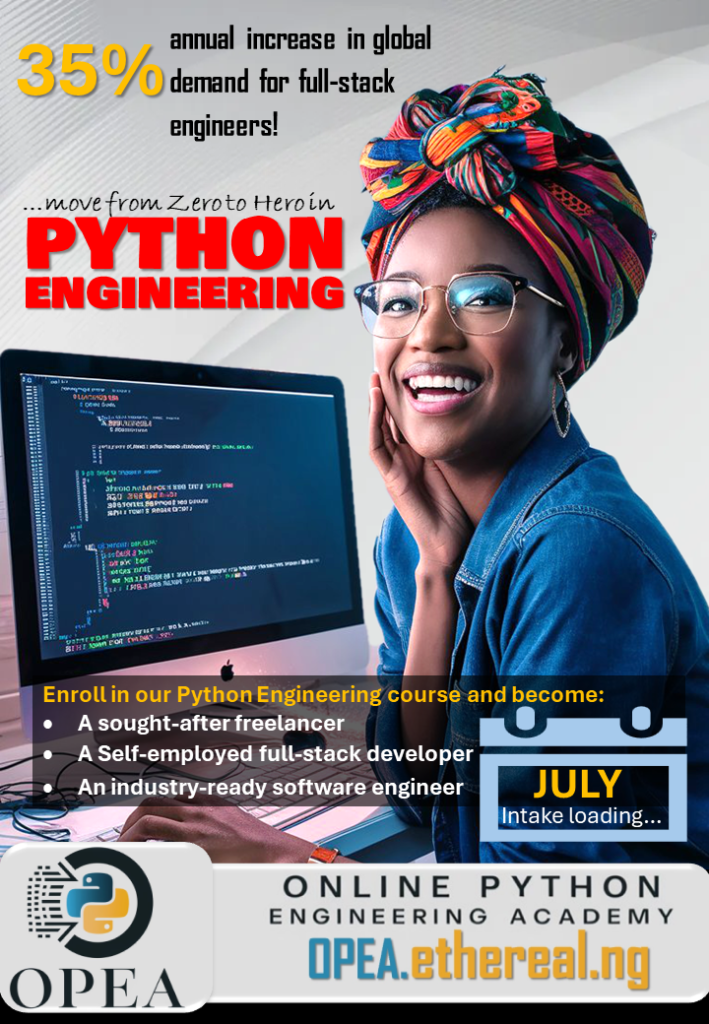
Python Engineering Course
We eagerly introduce our groundbreaking Online Python Engineering Course by Ethereal Multimedia Technology Ltd.
This intensive, hands-on program equips participants with skills for full-stack Python development. First, you’ll learn software engineering principles. Next, you’ll apply those principles to real-world projects. Then, you’ll integrate AI tools to streamline development. After that, you’ll gain practical experience building end-to-end solutions. Finally, you’ll explore industry best practices and trends.
Our Python Engineering Course highlights:
- Hands-on full-stack Python training
- Applying software engineering to projects
- Using AI tools for development
- Building complete software solutions
- Learning best practices and new trends
The course outcomes:
- Prepare self-employable full-stack developers
- Produce industry-ready software engineers
- Upskill entry-level IT staff for productivity
In summary, our program teaches cutting-edge Python full-stack skills. You’ll use AI tools and follow best practices. As a result, you’ll become an employable full-stack developer.
COURSE DESCRIPTION
This is an intensive hands-on training on the application of software engineering principles for full-stack development using Python programming language. The course will teach participants how to use AI to copilot full-stack software development.
AIM OF THE COURSE
To equip participants with the knowledge, skills, and practical experience necessary to become proficient in applying software engineering principles and leveraging artificial intelligence tools for full-stack development using the Python programming language.
OUTCOME OF THE COURSE
1. Prepare full-stack developers that are self-employable.
2. Produce industry-ready full-stack software engineers.
3. Upskill entry-level and intern staff for increased productivity in IT workplaces.
OUTPUT (DELIVERABLES) OF THE COURSE
1. Practical Python engineering projects.
2. Certificate of participation.
ELIGIBILITY
Be a graduate of Computer Science, Software Engineering, or any related field with some basic proficiency in any object-oriented programming skills (with evidence).
REQUIREMENTS
1. Laptop or Desktop Computer:
– Participants should have a personal laptop or desktop computer with sufficient processing power and memory to handle software development tasks.
– Recommended specifications: At least 8 GB RAM, Intel Core i5 or equivalent processor, and a minimum of 256 GB storage.
2. Operating System:
– Participants should have a compatible operating system installed on their computer.
– Supported operating systems: Windows 10/11, macOS (10.15 or later), or Linux (Ubuntu, Debian, or Fedora).
3. Internet Connectivity:
– Participants should have a stable and reliable internet connection to access course materials, collaborate with others, and download necessary software and tools.
Checklist:
1. Python Installation:
- Participants should have Python (version 3.7 or later) installed on their computers.
- They can download and install Python from the official Python website: https://www.python.org/downloads/
2. Integrated Development Environments (IDEs):
- Participants should have at least one Python IDE installed on their computer. Some recommended IDEs include:
- PyCharm: https://www.jetbrains.com/pycharm/
- Visual Studio Code: https://code.visualstudio.com/
3. Flet Framework:
- Participants should have the Flet framework installed on their Python environment.
- They can install Flet using the following command: `pip install flet`
4. Version Control System:
- Participants should have Git installed on their computers for version control and collaboration.
- They can download and install Git from the official website: https://git-scm.com/downloads
5. AI Copiloting Tools:
- Participants should have accounts or access to the AI copiloting tools, such as ChatGPT, Perplexity AI, Claude AI, Black Box AI, GitHub, and Devin AI.
- They should ensure they have the necessary API keys or authentication tokens to use these tools effectively.
6. Web Browsers:
- Participants should have modern web browsers installed on their computers, such as Google Chrome, Mozilla Firefox, or Microsoft Edge.
7. Additional Python Packages:
- Participants should have the following Python packages installed: NumPy, Pandas, Matplotlib, Scikit-learn, Flask, Django, etc.
8. Text Editor:
- Participants should have a text editor of their choice installed for editing code and configuration files.
- Some popular text editors include Sublime Text, Atom, or Notepad++.
9. Collaboration and Communication Tools:
- Participants should have access to collaboration and communication tools such as Slack, Zoom, or Microsoft Teams for group discussions, sharing resources, and seeking assistance.
10. Required Software Development Kits (SDKs) and APIs:
- Participants should have the necessary SDKs and APIs installed based on the specific requirements of the course, such as Flutter SDK, Android SDK, or iOS SDK.
DURATION
24 Weeks
SESSIONS
Weekends [Friday, Saturday and Sunday: 7:30 – 8:30 PM [Nigerian Time: GMT+1].
COURSE MODULES
MODULE 1: PRINCIPLES OF SOFTWARE ENGINEERING
Introduction
Software Development Lifecycle
Analysis
Design
Development
Testing
Deployment
Maintenance
MODULE 2: PYTHON PROGRAMMING WITH FLET FRAMEWORK
What is Python?
Readability and Simplicity
Extensive Standard Library and Third-Party Packages
Rapid Prototyping and Development
Cross-Platform Compatibility
Integration with Other Languages and Systems
Why Learn Python?
Computational Problem Solving with Python
Algorithmic Thinking
Data Structures and Algorithms
Problem Decomposition and Modularization
Testing and Debugging
Real-World Applications
Between Python and Software Engineering
Introduction to Flet
Why Flet framework?
Simplicity and Ease of Use
Cross-Platform Compatibility
Performance and Efficiency
Extensibility and Customization
Setting Up Python Development Environment
Why do you need a development environment?
Setting up Development Environment in PyCharm
Setting up Development Environment in VS Code
Getting Started with Flet
Create a New Flet App
Running Flet App
Publishing Flet App
MODULE 3: AI-DRIVEN FULL STACK PYTHON ENGINEERING
What is Python engineering?
Python Engineering Principles
Role of a Python Engineer
What is Full Stack Engineering
Front End (GUI or UI/UX)
Workflow (Logic, Algorithm, and Data Structures)
Back End (Database)
AI-Driven Full Stack Engineering
ChatGPT
Perplexity AI
Claude AI
Black Box AI
GitHub
Devin AI
Prompt and Prompt Engineering
Prompt
Prompt Engineering
The Need for Prompt Engineering in Full-Stack Engineering
A Practical Python Engineering Project
Analysis
Design
Development
Testing
Deployment
Maintenance
BONUS: Selling Your Scripts Online
TUITION
| MODULE | COST (N) |
| MODULE 1: Principles of Software Engineering | 25,000 |
| MODULE 2: Python Programming with Flet Framework | 50,000 |
| MODULE 3: AI-Driven Full Stack Python Engineering | 75,000 |
| TOTAL | 150,000 |
PAYMENT DETAILS
Bank Details:
Guaranty Trust Bank (Naira Account)
Account Name: Ethereal Multimedia Technology Limited
Account Number: 0170036202
Account Type: Current
RESOURCE PERSON
Etemi Joshua Garba (PhD, MEng, BSc) is an expert and a consultant in Software Engineering, Digital Economy and Multimedia Technologies. He is the CEO and Co-Founder of Ethereal.ng (a tech startup).
Etemi Joshua Garba is a university professor with almost 20 years of experience in teaching, research and community service. He is a member of the Nigeria Computer Society (NCS), Computer Professionals (Registration Council of Nigeria) CPN and the Institute of Electrical and Electronics Engineers (IEEE).
He was a facilitator in software analysis and training at the Social Media and Mobile App Campaign Workshop in Ghana (funded by Media Response and the International Organization for Migration [IOM]). Consequently, he developed the software specification requirements document to design, develop and deploy the FMM West Africa Migrant App. The project was funded by FMM West Africa, EU, ECOWAS, IOM, ICMPD and ILO.
Etemi Joshua Garba is a member of the stakeholders for developing the Nigerian Electronic Commerce Regulation at the National Information Technology Development Agency (NITDA), Abuja.
He was part of the panelist at the Northeast regional town hall meeting for the Nigeria Startup Bill that took place in 2021. He was one of the stakeholders who contributed to the bill’s passage into law. He also participated in the NITDA’s Stakeholders Engagement and Ecosystem Development Programme that took place in Yola, Adamawa State on the 21st of September, 2023.
JOIN OUR COMMUNITY
Online Python Engineering Academy powered by Ethereal Multimedia Technology Ltd.